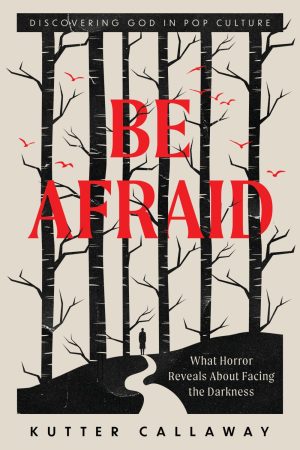
 August 2026 | LISLE, IL—InterVarsity Press (IVP) is kicking off a new Discovering God in Pop Culture series with a book from Kutter Callaway titled Be Afraid: What Horror Reveals About Facing the Darkness. Releasing on September 29, 2026, this first title in the series engages popular horror narratives to ask what our deepest fears reveal about what we truly love, long for, and believe.
Zach Gordon, acquiring editor for the series, said, “Kutter’s book sets the tone for the rest of the series. We’re moving beyond the usual, less interesting questions that have dominated faith and pop culture discussions, most of which have centered on identifying religious themes and determining whether it is permissible for Christians to engage with pop culture. Instead, we’re focusing on more interesting questions. How can Christan faith be enriched and made better by an informed engagement with pop culture? How can pop culture provide a way of understanding that illuminates theology? Kutter’s opening book absolutely nails these goals. The prose is engrossing, and the ideas are challenging and illuminating in all the right kinds of ways. I’m extremely excited for IVP to share the book with the world. Whether or not readers are fans of the horror genre, this book will change the way they read the Bible and think about their faith.”
The Discovering God in Pop Culture series, edited by Callaway and Matthew William Brake, invites readers to see faith and popular culture in conversation. Brake, who is the associate professor of philosophy and religion at Northern Virginia Community College, said, “This series serves as a tool and resource for Christians who want to engage constructively with popular culture in their churches and educational institutions. Each book in the series introduces readers to a particular area of pop culture (e.g., a film genre, a music movement, a specific franchise), while providing a brief contextual background of its impact on the broader culture.”
One forthcoming book in the series is an offering from renowned theologian Soong-Chan Rah, who is writing with his son, Elijah Rah, on intergenerational and interfaith dialogue centered on popular contemporary films. Another Discovering God in Pop Culture title, authored by Andrea Robinson, will explore what anime reveals about the meaning of life.
Brake added, “This series will examine the theological questions raised by pop culture and engage with relevant theological scholarship, exploring the ways that the messages in popular culture may inform Christian faith and practice. However, each volume will also reverse the hermeneutical flow, which is to say it will not only examine the pop-cultural form and/in/as theology but will also explore the ways in which a deeper understanding of popular culture might illuminate our understanding of Christian theology.”
Rather than dismissing pop culture or accepting it uncritically, the series invites readers to discover how pop culture can help them to imagine and think about Christian belief and practice in new and creative ways. In Be Afraid, Callaway, a theologian and psychological scientist, explores how our Christian faith is made better when we engage with the horror genre.
Scott Derrickson, director of The Exorcism of Emily Rose, Sinister, and The Black Phone, said, “Horror art exists to confront what we deny, and Be Afraid fundamentally understands that. Kutter Callaway neither sanitizes nor exploits his subject but rather treats it with moral and emotional seriousness. By engaging horror films as a medium of truth, this book offers a rare and thoughtful conversation between theology and terror, between faith and dread. Be Afraid insists that when faced honestly, fear can be the beginning of wisdom rather than an enemy to avoid.”
According to Callaway, the Christian life isn’t about eliminating fear, it’s about redirecting it. This book offers a fresh, often funny, and deeply honest theological reflection on the shared fears and anxieties of our culture.
Callaway said, “I hope readers come away with a more honest relationship with darkness—their own and the world’s. Not a morbid one, not a despairing one, but an honest one. One of the things I’ve noticed in a lot of Christian communities is that we’ve lost what I’d call the muscle memory to sit in darkness. Our liturgies, our sermons, our whole formation tends to rush us from Good Friday to Easter without actually letting us stay in the tomb. And the result is that when people encounter real darkness—grief, fear, trauma, moral complexity—they feel like something has gone wrong with their faith. When actually, the Christian faith was always meant to be a resource for navigating exactly that kind of dark, chaotic, foreboding, and trauma-filled world.”
Founded in 1947 as an extension of InterVarsity Christian Fellowship/USA, InterVarsity Press serves those in the university, the church, and the world by publishing thoughtful Christian books that equip and encourage people to follow Jesus as Savior and Lord in all of life. For more information, visit ivpress.com.
Media Contact: Krista Clayton, kclayton@ivpress.com