Step Into a Captivating Poetic Conversation with Beloved Christian Poets that Spans Centuries
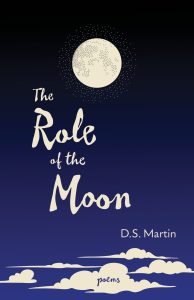 Orleans, MA – February 19, 2026 – The Role of the Moon by D.S. Martin has been awarded a Gold Medal in the 2026 Illumination Christian Book Awards in the “Poetry” category.
As the world experiences a renewed interest in poetry as a source of solace and reflection, award-winning poet D.S. Martin offers The Role of the Moon—a striking new collection that revives the depth and beauty of metaphysical poetry for today’s readers. This collection draws from the timeless themes of faith, loss, transcendence, and renewal, engaging in a vivid dialogue with literary giants such as John Donne, George Herbert, and Gerard Manley Hopkins.
In an era marked by uncertainty and spiritual searching, The Role of the Moon provides a literary sanctuary—offering thought-provoking verse that echoes both the struggles and aspirations of the modern soul. The book arrives at a time when contemporary poetry, particularly works exploring faith and existential meaning, is experiencing a surge in readership. Amidst this revival, Martin’s work uniquely bridges past and present, reinterpreting the traditions of Milton, Shakespeare, and Dickinson, and many others through fresh, evocative language. A “new metaphysical” voice emerges, connecting the past to the present with wit, poignancy, and striking originality.
Sydney Lea, former Vermont Poet Laureate (2011–2015), praises the collection as “a moving homage to the Metaphysicals, using metaphor as they did to grapple with supernal truths.”
Likewise, Rowan Williams, former Archbishop of Canterbury (2002–2012), calls it “a formidable achievement” in its profound conversation with John Donne and his legacy.
About the Poet
D.S. Martin is a Canadian poet, Series Editor for the Poiema Poetry Series, and Poet-in-Residence at McMaster Divinity College in Hamilton, Ontario. The most recent of his previous poetry books are Angelicus (2021) and Ampersand (2018). ISBN: 9798893480177 |On Sale 10.14.2025 | 5.5 x 8.5 | 128 pp. | Paperback | $21.00
Praise for The Role of the Moon
“The Role of the Moon comprises D.S. Martin’s moving homage to the Metaphysicals, using metaphor as they did to grapple with supernal truths. Almost arbitrarily, I’d call especial attention to “Prayer,” the uncanny opening poem of its fourth section, because the sequence synopsizes so much of what this luminous collection offers: it is at once humble and ambitious, vernacular and high-rhetorical. Most importantly, like the book at large, it epitomizes the example the poet means to follow. In a headnote he writes of the Metaphysicals that, because they “were deeply dedicated to their Christian faith … much of their poetry expresses their wrestlings with God, and with their own weaknesses.” Few beside Martin himself could, without the least pretension, undertake to emulate such grand predecessors. We readers are blessed that Martin did.” Sydney Lea, Vermont Poet Laureate (2011—2015)
“Don Martin writes as always with an impressive blend of unobtrusive technical skill and a wonderfully innovative imagination. But the most distinctive gift of this collection is the sustained conversation with John Donne and the tradition he represents, producing a series of witty, poignant, searching interactions that bear many re-readings. A formidable achievement.” Rowan Williams, Archbishop of Canterbury (2002—2012)
“D. S. Martin’s The Role of the Moon is a conversation with the tradition of English-language Christian poetry—a strikingly creative one, because many are the books that play off of earlier poets, but few are those that, as here, achieve real originality and relevance. In vivid dialogue with Thomas Traherne, Gerard Hopkins, Christina Rossetti, Emily Dickinson, and many others, above all John Donne, Martin engages them in our world. Notable for agilely shifting tones, phrase-making ability, and an inventive combination of freedom and formality, these are alert and profound, memorable, often quotable poems. For instance, “New Life” is spurred by “The Windhover” (and also “God’s Grandeur” and “Spring” and even “No worst, there is none”) to say this: “Try your best to imagine the worst…/…the doom & dust passes, the fireweed / blueberries & grasses thrive the hopeless vacuum fills / with new desire…” And so for Martin, along with Hopkins, ‘there lives the dearest freshness deep down things.’ A. F. Moritz, Griffin Poetry Prize Winner
Media Contact: Danielle Bushnell, danielleb@paracletepress.com